RESEARCH NOTE
An introduction to my research
The interests, questions, and kinds of work I plan to explore across finance, mathematics, statistics, software, AI, and productivity.
Abstract
This note introduces the range of interests I plan to explore on this page, from finance, mathematics, and statistics to software, artificial intelligence, and productivity. I expect to publish research notes, longer articles, reviews, and technical explorations. The subjects differ, but I want to approach each with clear questions, careful use of evidence, and transparent limits on what its conclusions can support.
On this page
This page will be a place for me to work through ideas across several connected interests. It will not be limited to one discipline, one method, or one kind of publication. Some pieces will start with a mathematical question; others may begin with a paper, a piece of software, or a claim about how people work.
The common thread is curiosity about how systems behave, how we can understand them, and what evidence can support a useful conclusion. I want to use research as a way to examine questions carefully, not as a label that makes an opinion sound settled.
Areas I expect to explore
Finance is one part of this work. I am interested in markets, risk, investment, and the models used to reason about financial decisions. Questions might concern what can be forecast, how methods perform outside the data used to develop them, or what a backtest can and cannot establish.
Mathematics and statistics are both subjects in their own right and tools for answering those questions. I want to understand the assumptions behind a method, what it measures, and where its results become uncertain. Sometimes the useful outcome may be a model; sometimes it may be finding out that a simpler approach is easier to test or explain.
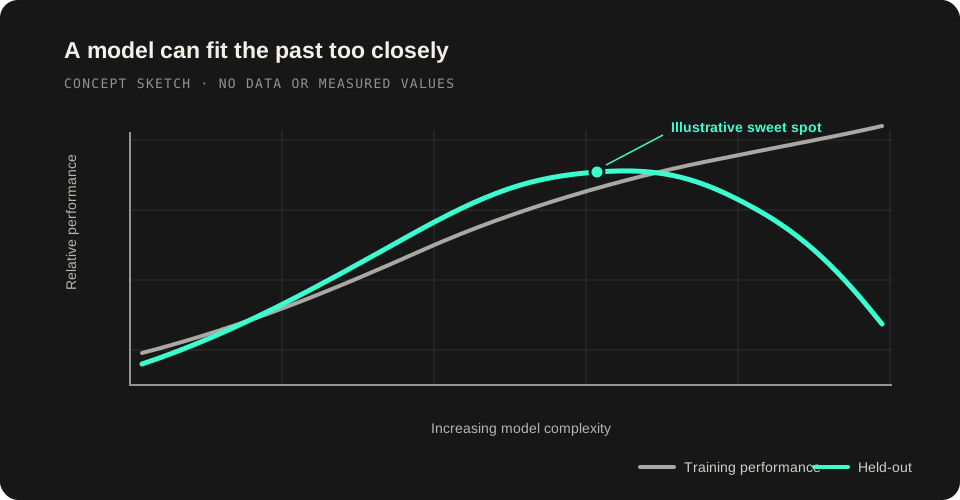
Concept sketch only, not a result or real dataset. It illustrates why I would check a model on data it was not trained on.
I also want to write about software and artificial intelligence: how these tools are built and used, what they make easier, and where their limits show up in practice. That connects naturally to productivity. I am interested in what changes when a person or team adopts a new tool or workflow, but claims of improved productivity need more than a faster-looking demonstration. The task, the quality of the result, the time saved, and the work shifted elsewhere all matter.
These areas may overlap, but they do not have to be forced into a single subject. A project might use code to test a statistical idea, examine AI in a software workflow, or study how a financial model informs a decision. Other interests may find their way here too.
What I plan to publish
This page will include several kinds of work:
- Research notes for questions in progress, reading notes, exploratory analysis, and methods I am still testing.
- Articles for topics where I have developed a fuller explanation or argument, supported by relevant evidence.
- Reviews of research papers, methods, software, or tools. These will distinguish what the source says from my assessment of it.
- Technical explorations that use mathematics, statistics, data, or code to make an idea concrete.
Not every note will be a finished result, and not every article will report original empirical work. I will try to make clear whether a piece is exploratory, explanatory, evaluative, or a report of a completed analysis. When I discuss another person’s work, I will credit it and distinguish a summary or critique from a replication of its findings.
How I want to approach the work
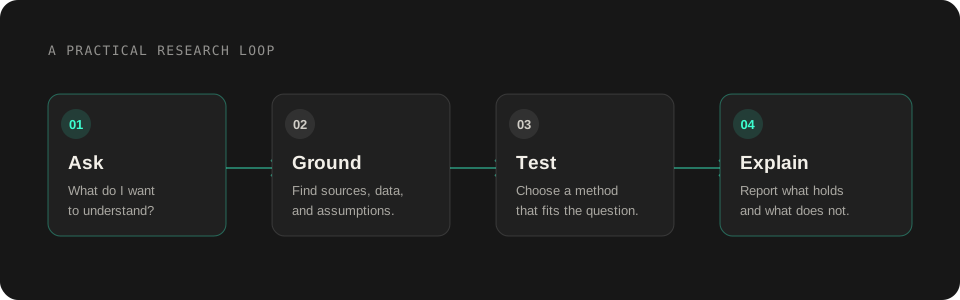
An outline, not a fixed recipe: the right sources and methods depend on the question.
I want each piece to make its question and scope clear. For quantitative work, that means explaining the data, definitions, assumptions, comparison, and evaluation method. For a review, it means engaging with the actual paper or tool rather than relying on a headline or a short description. For writing about software or productivity, it means being specific about what changed and what evidence would count as an improvement.
Where practical, I will share sources, code, and enough detail for readers to follow the reasoning. I will also note limitations: what the data does not cover, which assumptions matter, and what I have not tested. A result that does not support the original idea is still worth recording if the process was sound and the conclusion is stated honestly.
The examples and questions on this page may come from Botswana, elsewhere in the region, or international work. My interests are not confined to one geography. The scope should follow the question and the available evidence.
An evolving programme
I do not yet have a fixed list of projects or a single research agenda. One possible question is whether some measures of financial risk are easier to forecast than returns. Elsewhere, I may examine a research paper, test a software method, or look at how people use AI in their work. These are starting points, not promises or findings.
I want this page to show the work as it develops: what I read, what I test, what I change my mind about, and what the evidence can support. The aim is to make the reasoning visible, whether the final piece is a short note, a review, or a longer article.